
Contract EMS: Solutions Manufacturing Unifies Operations on a Modern Manufacturing ERP
Solutions Manufacturing, a contract EMS company, replaced a legacy ERP and disconnected quoting system, establishing a structured foundation for BOMs, inventory, and production data.
About Solutions Manufacturing
Solutions Manufacturing is an electronics manufacturing services (EMS) provider based in Rockledge, Florida, operating in a high-mix, low-to-medium volume contract manufacturing environment. The company supports aerospace, medical, and industrial customers.
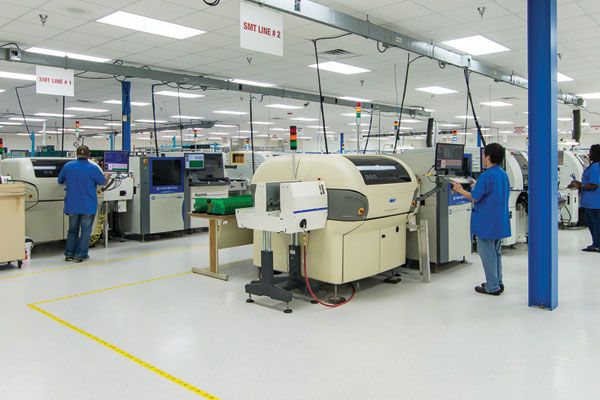
Their work spans PCBA, box build, test, and material management. With multiple SMT lines and integrated inspection processes, the business handles a wide range of builds with different materials, requirements, and timelines.
That creates constant variation across jobs. Different customers, different assemblies, different constraints. In a contract manufacturing environment, the system has to support that variation without slowing production or creating gaps in data.
The Problem
A Workaround-Driven System
As the business grew, the limitations of their systems became harder to ignore. Solutions operated on a legacy ERP system paired with a separate quoting tool. The ERP had been in place since the 1990s and was modified over time to fit the business.
The system functioned, but required workarounds. Data was stored in inconsistent formats, often in text fields that could not be structured into reports. Checking inventory levels, shortages, or job status required exporting data and rebuilding it outside the system.
This led to:
- Manual data entry across quoting, inventory, and production
- Reliance on tribal knowledge to interpret system data
- Delays in locating part, work order, and inventory information
It worked, but mostly because people knew how to work around it.
Part numbering created additional friction. Internal part numbers duplicated manufacturer part numbers, which complicated purchasing, inventory alignment, and BOM management.
At that point, the system was limiting how the team could manage inventory, quoting, and production together. The issue wasn’t a single feature. It was the lack of unifying structure across the entire company.
The Goal
Establishing Structure
The decision to replace the system followed directly from those constraints. The goal was to establish a consistent structure for how data is created, stored, and used across the business.
Solutions needed a solution that could:
- Replace both ERP and quoting systems
- Reduce manual effort required to maintain data
- Make inventory, BOM, and job data usable without cleanup
As part of the transition, the team made a strategic decision to change how part data was managed, moving away from internal part numbers and aligning everything to manufacturer part numbers, knowing it would require more work during implementation.
That decision set the direction for the rest of the implementation.
Why Cetec ERP Fit Their Business
With those requirements defined, the team evaluated between 20 and 30 ERP systems.
They needed a broad, all-encompassing system that could support a complex high-mix contract electronics manufacturing environment.
Specifically, they needed:
- One system to manage quoting, BOMs, purchasing, inventory, and production
- Structured data that could support reporting without manual work
- Control over item master data and part numbering, including substitute and alternate parts
- Support for high-mix jobs with varying BOMs and requirements
They ultimately implemented CalcuQuote, a best-of-breed quoting and supply chain platform for EMS companies, alongside Cetec ERP for manufacturing, inventory, purchasing, and financials, selecting two tightly integrated systems that support the entire quote-to-cash process.
Cetec ERP replaced the legacy ERP and provided a single source of truth across inventory, purchasing, engineering, and production, while CalcuQuote handled the front-end quoting and supply chain processes. The integration between the two systems allows quote data, BOMs, and part information to flow directly into operations without re-entry or manual translation.
Cetec ERP also includes an embedded BI layer (Metabase), allowing the team to query operational data directly instead of exporting and restructuring it. As a result, real-time custom reporting is accessible and easy to manage, without exporting and reworking data.
Implementation Reality
Even with the right system selected, the transition required significant effort, with data migration as the primary challenge.
The legacy system stored multiple data points inside single fields, which meant separating and restructuring that data before it could be imported. Changing part numbering added another layer, requiring physical verification of inventory and alignment to manufacturer part numbers. That process also exposed inventory that was no longer needed.
Internally, the project had a dedicated owner responsible for evaluation, implementation, and coordination with external partners. Betsy Cunnane, Strategic Initiatives Manager, at Solutions Manufacturing, described the transition:
“We worked closely with CalcuQuote on the implementation, and they did a great job. But at the end of the day, you still need someone internally who understands your business and can own the process.”
The team also planned for failure scenarios ahead of go-live, including the possibility of pausing production if data did not reconcile correctly. In practice, the transition went smoothly, but only because of the preparation leading into it.
What Changed
Once the system was in place, the primary impact was reflected in the increased speed and ease of daily tasks and responsibilities across the business.
Engineering workflows improved through structured BOM management. BOMs can be loaded, revised, and maintained without manual formatting or rebuilding data outside the system.
Access to operational data improved. Users can locate inventory, job status, and part data without relying on a specific person to run reports or interpret exports.
“It’s pretty user-friendly, so it wasn’t hard for most people to pick up. Once they had access to the data, they could usually find what they needed without relying on someone else.”
Reporting shifted from exported data to working directly from the system, with the team building and adjusting reports based on current data.
“With the reporting tools, especially in Metabase, we can shape the data around how we work. If something isn’t helpful, we build what we need instead of forcing a report to fit.”
The team extended this further with custom queries, including real-time production status and job progress tracking across active work orders.
On the production side, the team manages partial builds and job splits within the system. Work orders can be adjusted as production progresses, and job status reflects current activity on the floor.
“We worked with the Cetec team to build out some functionality around splitting orders, since we do a lot of partial builds. That’s made it much easier to track where things are and manage production as it happens.”
The cumulative value is a system Solutions Manufacturing can grow with, rather than work around.
Results
In practice, that shows up across engineering, purchasing, and production in a few key ways:
- Reduced manual data entry across quoting, inventory, and production
- Faster access to inventory levels, shortages, and job status
- Elimination of duplicate part numbering between internal and manufacturer parts
- Structured BOM management for engineering and production
- Real-time tracking of job progress, including partial builds and split orders
“With better access to data, people can find what they need quicker instead of relying on someone else to pull it for them.”
The result is less time spent locating information and more time acting on it.
Growing Into the System
With the core system in place, the focus shifted from implementation to expansion.
The team is extending how they use Cetec ERP across inventory management, stockroom processes, and coordination between planning, purchasing, and production.
These are extensions of the same dataset and workflows already in place. The structure is already there. The work now is applying it consistently across departments.
As requirements grow, the system supports additional reporting, planning, and production control without introducing new tools.
Final Perspective
The transition required restructuring data, standardizing part numbers, and aligning processes across departments.
The result is a system that brings quoting, inventory, and production onto a single dataset.
“All things considered, it went smoother than we expected. There were definitely challenges, but overall it was a positive experience. We would choose Cetec ERP again.”

Run your entire business inside one integrated system designed for small and mid-sized manufacturers.